Robotics · Egocentric video
Egocentric video data for robotics and physical AI.
We capture and annotate real-world, first-person video — from wearable and head-mounted rigs through to ML-ready, labelled datasets. First-person is the hardest modality to hold consistent across a multi-quarter programme, and the one gig platforms cannot deliver. Our specialists hold the taxonomy from pilot to production.
The modality
First-person video, the way a robot will see it.
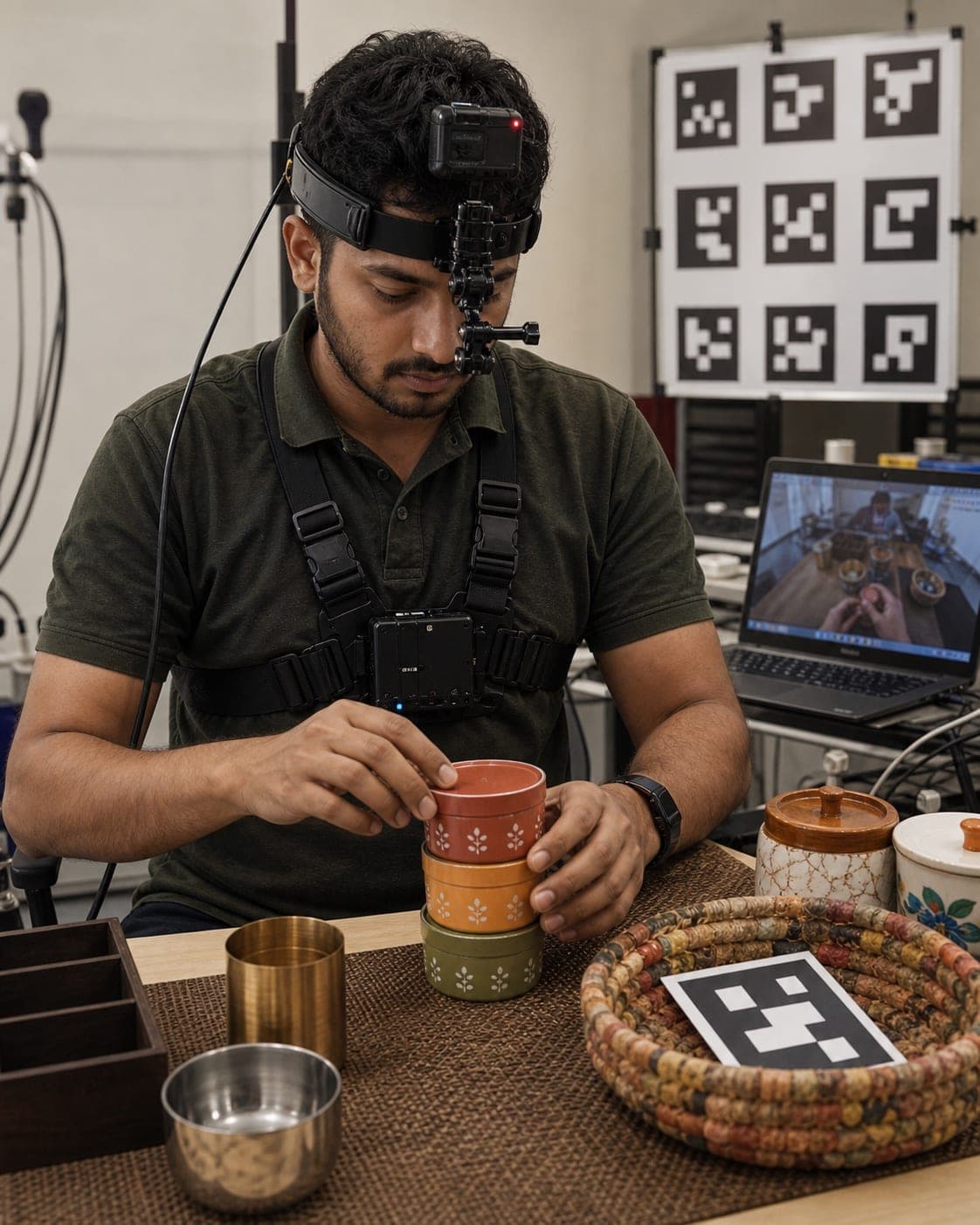
Egocentric video is recorded from the wearer's point of view, usually from a head-mounted or chest-mounted camera. It keeps what third-person footage loses: the changing viewpoint, the hands entering and leaving frame, the way an object is gripped and handed off, the scene as the task actually unfolds. That first-person record is what a humanoid or physical-AI model learns a task from.
What we do
Capture it, then label it.
Collection
Capture programmes built around your model
Wearable and head-mounted POV recording. Task-based demonstrations of fine-motor and multi-step actions, across indoor and outdoor environments. Every session is metadata-linked and delivered ML-ready, against a protocol we set with your team before recording starts.
Annotation
Grasp segmentation & action labelling
Per-frame segmentation of hands, gripped objects, and action boundaries. Calibrated rubrics for partial grasps, re-grasps, and object hand-offs. Consistent across multi-session training runs.
Scene parsing & affordance labelling
Object classification, affordance mapping, and navigable-space parsing from the first-person perspective. Built for both whole-scene understanding and object-specific interaction.
Action recognition & temporal segmentation
Temporally-grounded action labels with clean start/end boundaries. Disagreement-aware sampling for ambiguous transitions. Suitable for action-recognition models and VLA training.
Safety-critical flag review
Senior-reviewer tier for safety-critical scene classifications. On-call coverage available for deployed systems.
How it works
How a programme runs.
Capture planning
We set the protocol with your team: tasks, environments, camera placement, session count, and the label schema the footage has to support.
Participant & environment prep
Participants briefed, consent handled, environments staged so every session is usable and comparable.
Recording
Sessions recorded to the protocol, checked for stable capture and clear hand-object visibility as they happen.
QA & review
Human review for protocol adherence, framing consistency, and metadata completeness before anything moves downstream.
ML-ready delivery
Structured, metadata-linked datasets — annotated to your schema if you want the label layer too.
What it trains
Built for the models physical AI runs on.
Robot imitation learning
Teach a task from a first-person demonstration.
Physical AI
Ground models in real-world action, not simulation alone.
Vision-language-action models
Pair what is seen with what is done.
Egocentric action recognition
Classify actions from the wearer's viewpoint.
AR / VR interaction
Understand how hands meet objects in space.
Human activity recognition
Read multi-step behaviour as it unfolds.
Manipulation & hand-object interaction
Capture grip, re-grip, and hand-off.
Context-aware perception
Hold scene context across a changing view.
Platform-agnostic by default.
Encord. Labelbox. V7. Scale AI. Roboflow. Internal tooling. We deliver specialists on whichever platform your team runs — including the ones built specifically for robotics data.
Questions
Common questions.
- What is egocentric video data?
- First-person video recorded from a wearable or head-mounted camera. It captures the viewpoint, hand movements, and object interactions a model needs to learn a physical task — the perspective the robot itself will operate from.
- Do you collect the footage, annotate it, or both?
- Both. We run capture programmes from scratch and we annotate footage you already hold. Most robotics teams take both; some come to us only for the label layer.
- What recording setups do you support?
- Head-mounted and chest-mounted POV rigs, single or multi-camera. We agree the setup against your model's needs during capture planning, not after.
- Can you run a pilot before a full programme?
- Yes. A scoped pilot proves the protocol and the label schema on a small batch before you commit to volume.
- Will the datasets come with metadata?
- Every session is metadata-linked — task, environment, participant, timestamps — so the data drops straight into your ML workflow.
- What annotation can you add?
- Grasp segmentation, action and temporal segmentation, scene and affordance parsing, and safety-critical review. Labelled to your schema, on your platform.
- How do you keep quality consistent across a long programme?
- The same retained specialists stay on your taxonomy from pilot to production. That continuity holds 98.7% accuracy across multi-quarter runs, where gig platforms cannot.