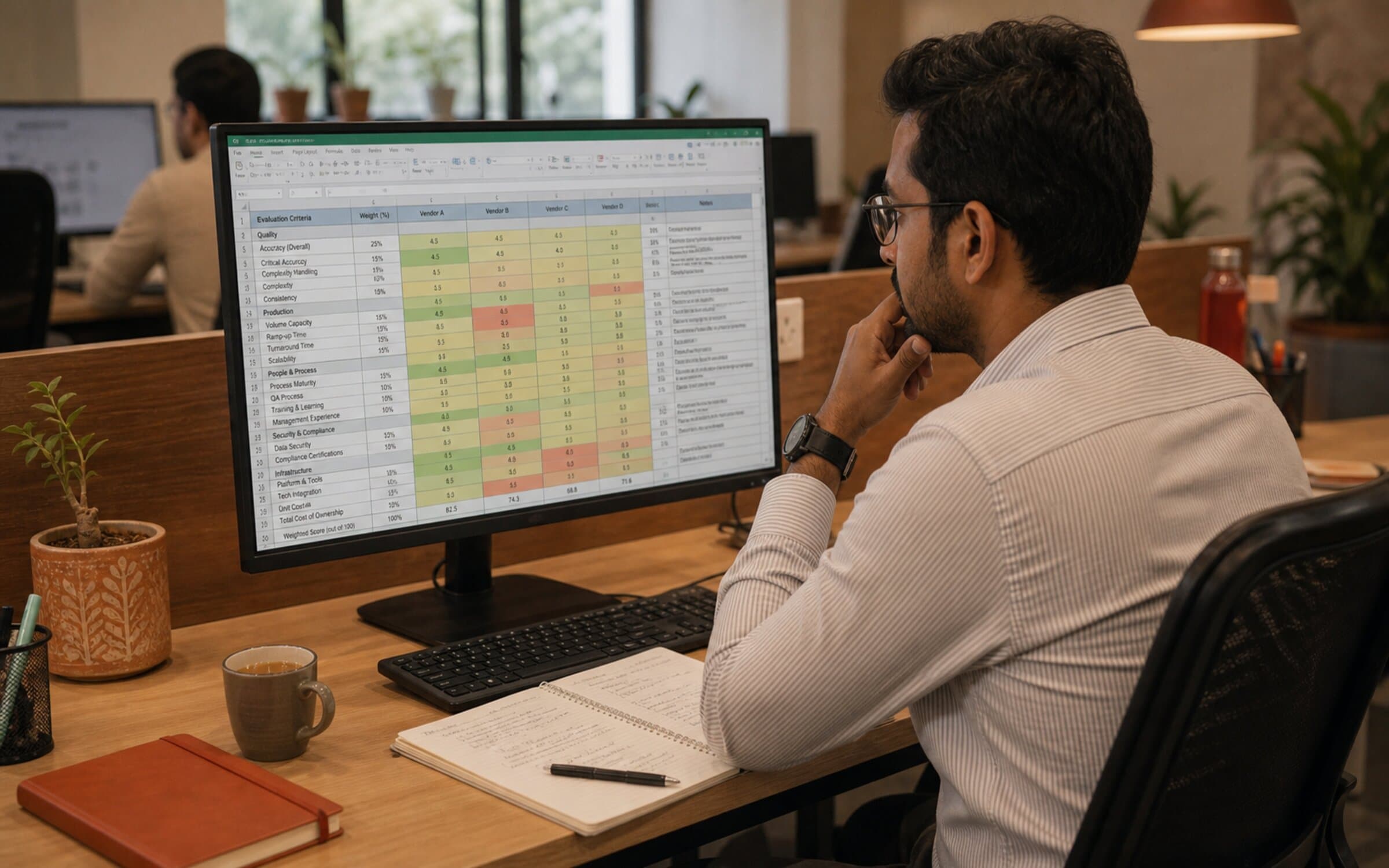
How to select an annotation vendor for agricultural technology
The quality of the labels on your crop imagery determines whether the downstream model learns agronomic patterns or memorises noise. A vendor with crop-science expertise applies annotations that travel correctly into the model and out the other side as field-ready recommendations.
AgTech annotation requires vendors with: (1) demonstrated crop-science expertise (not generic image labelling), (2) experience with high-throughput phenotyping platforms (drone imagery, multispectral data, field-scale datasets), (3) understanding of seasonal variation and growth-stage challenges, (4) ability to handle edge cases (disease stages, weed identification, soil texture). IndiVillage's Taranis partnership (50M+ acres analysed annually, 4.5M images over 18 months, zero drift on disease classification) demonstrates this specialisation. Selecting a general vendor for AgTech misses the domain-specific edge cases that make or break crop models.
Why AgTech annotation is domain-specific
Crop diseases progress through stages: leaf spot → lesion expansion → systemic infection. A vendor unfamiliar with plant pathology will misclassify early-stage blight as healthy foliage, and that error travels into your model. Weeds differ by region. Soil texture varies by geography and season.
A vendor experienced in general object detection (cars, pedestrians, boxes) will struggle with:
- Phenotypic variation: The same crop (wheat) looks different at growth stages (seedling vs. boot vs. grain fill); a vendor without crop knowledge will require constant clarification
- Disease progression: Early blight and late blight look different; a vendor without plant pathology knowledge will confuse them
- Environmental context: Stress symptoms (drought, nutrient deficiency, disease) can look similar; telling them apart requires agronomic knowledge
- Scale and resolution: Drone imagery is sparse and low-resolution compared to consumer cameras; a vendor used to sharp close-up images will struggle with field-scale analysis
Selecting a domain-expert vendor saves weeks of training and prevents systematic classification errors.
Vendor evaluation checklist for AgTech
Crop Science & Plant Pathology Expertise
- Team includes someone with agronomy or plant science background (degree, certification, or 5+ years field experience)
- Can articulate differences between crop growth stages and their visual markers
- Can name common diseases for major crops (soybean rust, corn gray leaf spot, wheat leaf rust) and describe symptom progression
- Has worked with farmers, breeders, or agronomists (not just data scientists)
- Understands weed identification by region (knows regional flora, not just "weed" as a generic category)
High-throughput phenotyping and scale
- Case study with high-volume crop dataset (1M+ images) or acre-level analysis (10M+ acres)
- Experience with drone imagery (not just ground-level photos)
- Experience with multispectral data (NDVI, red-edge, thermal) or orthomosaics (large-scale field stitched images)
- Documented throughput at scale (what's the pixel density they can handle? How many images per farm per season?)
- Platform integration experience (has worked with Taranis, Rogo, descartes Labs, Ag tech SaaS platforms)
Seasonal and temporal understanding
- Understands phenological variation (growth stage changes within a season)
- Has handled multi-year datasets (crop rotations, carry-over diseases, practice changes)
- Can manage taxonomy changes mid-season (new disease emergence, new weed population)
- Recognizes edge cases: nutrient stress vs. disease, drought stress vs. disease, soil texture variation
Weed identification and edge cases
- Can reliably identify 10+ common weeds by region
- Understands weed life stages (seedling, rosette, bolt, seed set) and variation
- Has handled "unknown weed" categories (customer-provided samples, novel species)
- Recognizes volunteer crop (previous crop regrowth) vs. weed vs. desired crop
Soil and environmental analysis
- If soil analysis is required: experience with soil texture classification, compaction assessment, or organic matter estimation
- Understanding of seasonal soil variation (moisture, frost cracks, compaction depth)
- Experience with thermal imagery or other non-RGB modalities
Process discipline
- Quality assurance protocol documented: how often do they re-audit crops for consistency across seasons?
- Taxonomy versioning and change logs (seasonal updates tracked and communicated)
- Drift detection (month-to-month accuracy trending)
- Farmer or agronomist feedback integration (how do they incorporate field-test results into taxonomy refinement?)
Red flags for AgTech vendors
"We've done crop image labelling" (no crop-science context)
This is a red flag. Ask: "What crops? What regions? What diseases or issues did you identify?" If the vendor struggles to answer, they lack domain expertise.
No experience with multispectral or high-resolution orthomosaic data
AgTech commonly uses drone orthomosaics (100MP+ images of entire fields). General vendors trained on small images will struggle with these data types. Ask: "Have you worked with orthomosaics? What's the largest image you've processed? At what pixel density?"
Cannot explain regional crop differences
Ask: "What weeds are common in Midwestern soybean fields vs. Australian farms?" If the vendor says "weeds are weeds," they lack regional knowledge. Agricultural vendors should know major crop rotations, regional pest profiles, and varieties by region.
No involvement with agronomists or farmers
Vendors embedded in agriculture have farmer feedback loops and agronomist review. Vendors without these connections are relying on data alone, not domain knowledge. Ask: "Do you work with agronomists or farmers? How do they review your work?"
"We use AI to label crops automatically" (no human review)
Automated crop annotation is risky. Early blight and late blight are difficult to distinguish even for human pathologists. Any vendor claiming fully-automated crop classification is taking unjustified risk. Ask: "What's your human review protocol? Do agronomy experts validate automated classifications?"
Vendor selection process for AgTech
1. List candidates (4–6 vendors)
Use searches: "agricultural annotation," "crop disease labelling," "drone image annotation agtech." Note: Many general annotation vendors claim agriculture experience; filter by demonstrated crop-science expertise.
2. Request case studies (specific crops, geographies, results)
Ask: "Show us a case study with: (1) crop name and variety, (2) geography, (3) image count, (4) diseases/issues annotated, (5) accuracy on your gold-set testing." Generic case studies don't count.
3. Technical interview with their AgTech expert (15–30 min)
Questions:
- "Describe your experience with soybean disease annotation. What diseases? What regions?"
- "Have you worked with drone imagery? What's the largest image file size you've processed?"
- "What's your process for handling edge cases like early-stage disease or stress symptoms?"
- "How do you detect and prevent drift when annotators work on the same crop for months?"
Listen for: domain knowledge, specificity, examples from real projects, willingness to admit gaps.
4. Pilot agreement (start small, validate)
Agree to a 1,000–2,000 image pilot on your most important crop/region:
- Clear success metrics: accuracy ≥95% on a gold set of 50–100 expert-annotated images
- Timeline: 3–4 weeks
- Cost: £2,000–£5,000
- Include inter-rater agreement testing (get two independent annotators; target ≥90% agreement)
5. Reference call with existing AgTech customer (if available)
Ask: "Were they easy to work with? Did accuracy hold up at volume? Have you had to iterate the taxonomy? Would you hire them again?"
Common AgTech vendor mistakes
Hiring general-purpose vendors and expecting crop expertise to develop
Training a general vendor to do crop annotation takes 4–8 weeks and produces systematic errors (confusion between disease stages, regional variation misses). Hire domain experts from the start.
Over-automating crop classification
Early-stage disease, stress symptoms, and weed seedlings are genuinely difficult edge cases. Vendors automating these without human review are cutting corners. Trust human expertise + AI, not AI alone.
Not accounting for seasonal variation
If your pilot is in spring (seedling stage), expect accuracy drift in summer (boot stage, taller crops, more complex backgrounds). Pilots should span seasons if possible, or annotators should be trained on phenological variation.
Ignoring regional variation
Weeds differ by region. Diseases vary by climate. A vendor trained on Corn Belt imagery may misclassify weeds in the South. Either hire regional experts or conduct training on region-specific imagery.
Missing edge cases
Volunteer corn (previous year's corn regrowth) looks like desired crop but is a problem. Nutrient stress looks like disease but is agronomy-fixable. Early-stage disease looks like healthy. Pilots should explicitly test these edge cases.
Proof: Taranis case
IndiVillage analysed 50M+ acres annually for Taranis (agricultural intelligence platform) over 18 months, maintaining zero drift on disease classification and increasing complexity over time (from early-season pest scouting to mid-season disease progression). This level of accuracy sustained across volume and seasons demonstrates deep crop-science expertise. The partnership works because both teams understand phenology, disease progression, and regional variation.
FAQ
Q: Can a general annotation vendor learn AgTech on the job? A: Yes, but it's expensive. 4–8 weeks of training, systematic errors during the learning curve, and ongoing domain gaps. Hiring domain experts upfront is faster.
Q: Do we need a vendor who's worked on our specific crop? A: Preferred, not required. A vendor with expertise in row-crop diseases (corn, soybean, wheat) can transfer knowledge to a new crop faster than a vendor with no row-crop background. Look for transferable domain knowledge.
Q: What if our region is underserved? (Smaller crops, niche geographies) A: Hire a vendor with similar crop/climate knowledge and conduct a longer pilot. A vendor experienced in Mediterranean crops may transfer well to new geography with similar pests and seasonality.
Q: Should we use crowd-sourced annotation for AgTech? A: Not for disease or pest identification. Gig workers lack agronomic knowledge and cannot reliably distinguish similar diseases or pests. Use dedicated teams with crop-science training.
Q: How do we handle new diseases or pests mid-season? A: Discuss this in pilot: how does the vendor handle taxonomy changes? Can they quickly re-train annotators on new classifications? Document the change-management process.
Q: What's the cost difference between general vendors and AgTech specialists? A: AgTech specialists deliver higher accuracy and fewer revisions. Domain expertise prevents systematic misclassifications and maintains accuracy at scale.
The mechanism of AgTech vendor trust
AgTech annotation is not a generic service. Crop disease classification, weed identification, and phenological understanding require specialist knowledge. Vendors with this knowledge catch edge cases, maintain accuracy at scale, and understand your customers' (farmers') needs.
IndiVillage's 96% annual retention over 16 years means disease taxonomy and regional variation knowledge compounds, delivering the zero-drift performance you need. Invest in a domain-expert vendor. The cost of wrong classifications (missed disease, false positives, weed misidentification) is high for your model's credibility with farmers.
JSON-LD Schema
{
  "@context": "https://schema.org/",
  "@type": "FAQPage",
  "mainEntity": [
    {
      "@type": "Question",
      "name": "How do I select an annotation vendor for agricultural technology?",
      "acceptedAnswer": {
        "@type": "Answer",
        "text": "AgTech vendors require: (1) crop-science expertise (agronomy, plant pathology background), (2) high-throughput phenotyping experience (1M+ images, 10M+ acres, drone imagery), (3) understanding of seasonal variation and growth stages, (4) ability to handle edge cases (disease stages, weed identification, regional variation). IndiVillage's Taranis partnership (50M+ acres, 4.5M images, zero drift) demonstrates this specialisation. General vendors lack domain knowledge and produce systematic misclassifications."
      }
    },
    {
      "@type": "Question",
      "name": "What are the red flags when evaluating AgTech vendors?",
      "acceptedAnswer": {
        "@type": "Answer",
        "text": "Red flags: (1) 'We've done crop labelling' without crop-science context; (2) no experience with multispectral or high-resolution orthomosaic data; (3) cannot explain regional crop differences or weed variation; (4) no involvement with agronomists or farmers; (5) claims fully-automated crop classification without human review. Ask specific questions: What crops? What regions? What diseases? Can they name regional weeds? If they struggle to answer, they lack domain expertise."
      }
    },
    {
      "@type": "Question",
      "name": "What expertise should be on the AgTech vendor's team?",
      "acceptedAnswer": {
        "@type": "Answer",
        "text": "AgTech teams should include: someone with agronomy or plant science background (degree, certification, or 5+ years field experience); ability to articulate crop growth stages and visual markers; knowledge of common diseases and symptom progression; experience with farmers, breeders, or agronomists; understanding of regional crop variation and weed identification. Domain knowledge should be demonstrated, not theoretical."
      }
    },
    {
      "@type": "Question",
      "name": "How do we structure an AgTech vendor pilot?",
      "acceptedAnswer": {
        "@type": "Answer",
        "text": "Pilot: 1,000–2,000 images, 3–4 weeks, £2,000–£5,000. Success metrics: ≥95% accuracy on gold-set (50–100 expert-annotated images), ≥90% inter-rater agreement (two independent annotators). Include edge-case testing (early-stage disease, stress symptoms, regional weeds). Reference call with existing customer. Pilot should span seasons if possible, or test phenological variation."
      }
    },
    {
      "@type": "Question",
      "name": "What's the cost difference between general and AgTech-specialist vendors?",
      "acceptedAnswer": {
        "@type": "Answer",
        "text": "AgTech specialists cost 15–30% more than commodity vendors but deliver higher accuracy and fewer revisions. The cost difference is worth it: domain expertise prevents systematic misclassifications (disease confusion, weed misidentification), maintains accuracy at scale, and understands farmer needs. Cost of wrong classifications (model credibility loss, farm practice disruption) exceeds vendor cost premium."
      }
    }
  ]
}
Last reviewed: 2026-05-26
Author: IndiVillage AgTech Partnerships Team
Category: AgTech / Vendor Selection