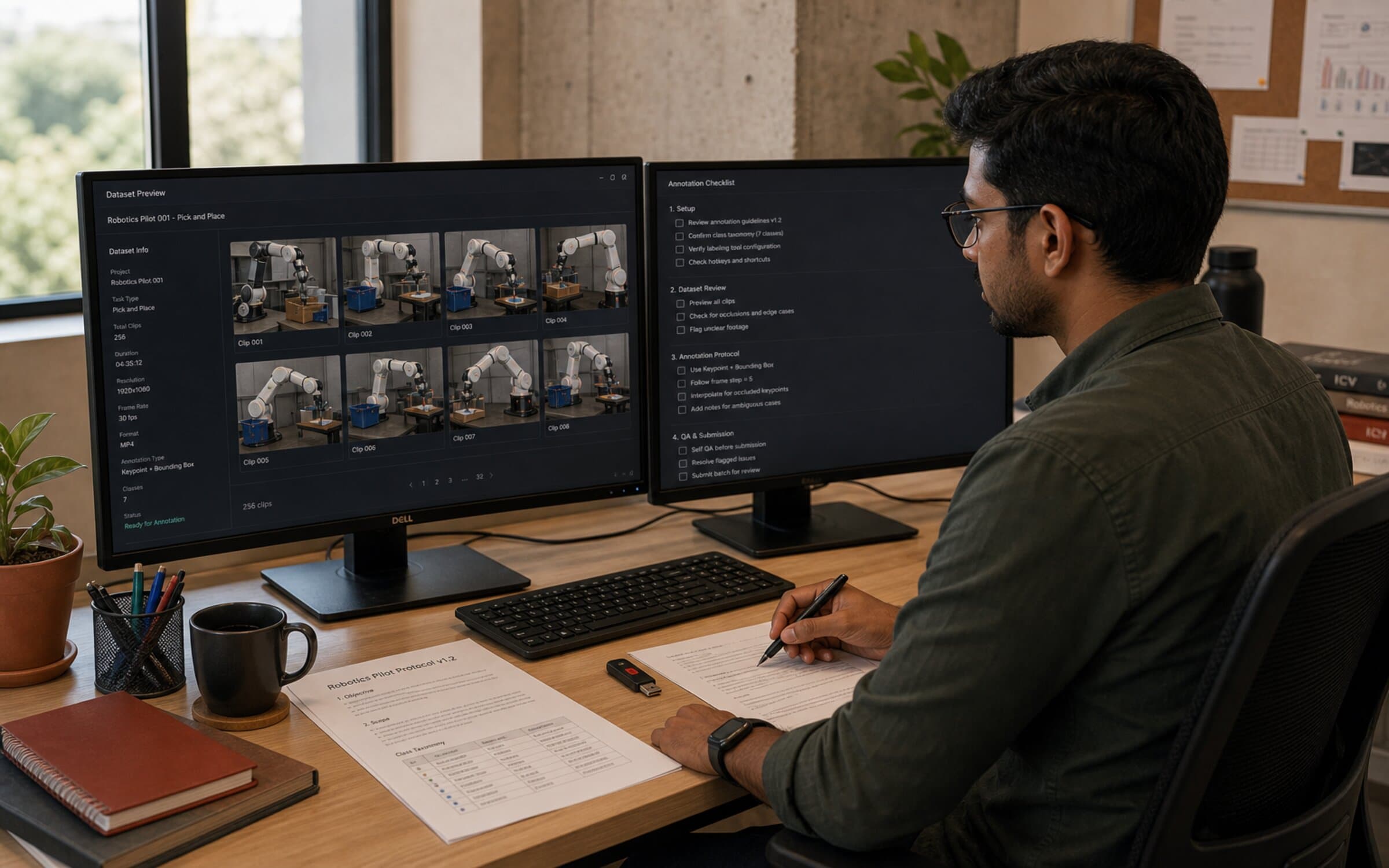
How Long Should a Robotics Annotation Pilot Take?
A well-designed pilot takes 4–6 weeks depending on image volume and complexity. The goal is not to annotate your entire dataset in pilot. It is to establish a baseline for quality, throughput, and cost scaling. Rushing a pilot (under 2 weeks) risks missing edge cases and misleads your ROI projections. Over-extending it (beyond 8 weeks) delays production launch without additional learning.
What a robotics pilot actually measures
A pilot answers specific questions: Can the vendor understand your taxonomy? What's the actual accuracy on your imagery? What's the throughput rate? What problems emerge as volume increases? Can they scale predictably?
The pilot is a 1,500–3,000 frame sample—enough to identify issues, not enough to annotate production workloads. Your model testing, edge-case discovery, and taxonomy refinement happen here. If the pilot succeeds, you move to production ramp. If it exposes gaps, you iterate on taxonomy or vendor capability before scaling.
Pilot timeline: week by week
Week 1: Setup and calibration
- Define your taxonomy in writing (frame types, object classes, bounding box rules, edge cases)
- Share sample imagery (20–50 frames) with the annotation partner
- Partner provides initial markup (rough output, not final quality)
- You review and provide calibration feedback
- Outcome: shared understanding of your requirements
Week 2: First batch delivery
- Partner annotates first 500–1,000 frames
- Internal review: does markup match your calibration feedback?
- Measure accuracy against your gold-set frames (if available) or expert review
- Document any systematic errors (all frames missing small objects? Bounding boxes oversized?)
- Outcome: baseline accuracy and throughput measurement
Week 3: Iteration and edge-case testing
- Provide feedback on Week 2 batch
- Partner annotates second batch of 500–1,000 frames (includes frames deliberately chosen to test edge cases)
- Measure accuracy improvement vs. Week 2 baseline
- Document any taxonomy updates needed
- Outcome: understanding of how the partner handles your toughest cases
Week 4: QA protocol testing
- Partner delivers frames with their own internal QA workflow
- You verify the QA methodology (how did they catch errors? What accuracy threshold triggered rework?)
- Measure final accuracy on reviewed batches
- Document the QA process for production scaling
- Outcome: confidence in their quality assurance discipline
Week 5–6: Production readiness and scaling simulation
- Partner annotates final batch (1,000–1,500 frames) at production pace
- Measure sustained accuracy (does quality hold as volume increases?)
- Document any throughput constraints (can they maintain this pace for 6+ months?)
- Agree on SLA and timeline for full production ramp
- Outcome: go/no-go decision for production launch
Cost breakdown: what you're paying for
Pilot scope and duration vary by modality and complexity:
- 2D bounding box annotation (cars, pedestrians, obstacles): 2,000-frame pilot baseline
- 3D cuboid annotation (robotics, autonomous vehicles): 2,000-frame pilot baseline
- Egocentric video annotation (robot grasp, manipulation): 1-hour video pilot baseline
- Keypoint annotation (pose, hand tracking): 2,000-frame pilot baseline
A structured pilot typically includes:
- Initial taxonomy review and clarification (no hidden setup fees)
- Annotator training on your specific requirements
- Multi-pass QA and accuracy review
- Pilot-specific iteration (extra review rounds, calibration feedback)
- Documentation of the process for production scaling
Do not accept flat per-batch pricing without accuracy guarantees. Do not accept throughput promises without a pilot baseline to measure against.
Benchmarking accuracy during the pilot
Accuracy measurement requires a gold set—10–20 frames that you or an expert annotator has marked at production quality. The vendor annotates these frames blind (without seeing your gold reference), and you compare their output frame-by-frame.
Calculate accuracy as: (correct frames / total frames) × 100.
For robotics, "correct" typically means:
- All objects detected (no missing objects)
- Bounding boxes within ±10 pixels of gold standard
- Class labels match exactly
- No hallucinated objects
Target pilot accuracy: 95%+. Anything below 95% signals taxonomy clarity problems or insufficient vendor training. Do not assume accuracy will improve in production—it tends to decay under volume and time pressure if baseline is weak.
Common pilot mistakes
Pilot too small (under 500 frames): You miss systematic errors. A vendor might handle static scenes perfectly but fail on motion blur, occlusion, or scale variance. You only discover this in production.
Pilot imagery not representative: If your production data includes night-time robotics, foggy conditions, or high-speed motion, your pilot must include these. A pilot on optimal imagery is a poor forecast for production accuracy.
No gold set defined: You'll argue about whether the vendor's accuracy is good. A gold set (your expert-reviewed reference) removes ambiguity.
Pilot timeline too aggressive: Under 3 weeks risks skipping the iteration step. You need at least one feedback-correction cycle to validate that the vendor can actually adjust to your requirements.
Over-committing to production SLA before pilot insight: If your pilot accuracy is 94%, don't promise 99% in production SLA. SLAs should be conservative—set them 2–3 points below pilot performance and tighten over time.
Not documenting taxonomy evolution: If Week 3 feedback changes how a class is defined, document it formally. Production annotators need this history to maintain consistency.
Success criteria for pilot completion
A pilot succeeds if you can answer all of these with confidence:
- Accuracy: Vendor achieved ≥95% accuracy on your gold-set frames and maintained it across all three batches.
- Throughput: Vendor delivered promised frames per week consistently (500–1,000 frames/week for 2D; 100–300 for egocentric video).
- Taxonomy comprehension: Vendor required ≤2 clarification rounds and no systemic misinterpretations by final batch.
- QA discipline: Vendor's internal review process caught their own errors and maintained accuracy above your threshold.
- Timeline predictability: Weeks 2–4 were delivered on schedule; no surprises in final week.
- Scalability confidence: You believe the vendor can maintain this quality at 3–5x the pilot volume over 6–12 months.
If you cannot confidently answer "yes" to all six, the pilot has not succeeded. Do not scale. Either iterate the pilot with the current vendor or evaluate alternative partners.
Pathway from pilot to production
Once pilot succeeds, establish a production ramp timeline:
- Weeks 1–2 of ramp: Scale to 1.5x pilot volume; introduce new image modalities if any; monitor accuracy closely (daily accuracy checks, not weekly)
- Weeks 3–6 of ramp: Scale to 3x pilot volume; stabilise throughput; shift to weekly accuracy reviews if baseline holds
- Weeks 7+: Full production volume; monthly accuracy reviews; quarterly SLA audits
Do not assume pilot accuracy extends automatically to production. As volume increases, quality tends to decline by 1–2 percentage points. Budget for this drift and plan QA accordingly.
FAQ
Q: Can we run a pilot on just 200 frames to save cost? A: You'll miss edge cases and systematic errors. 500 frames is the practical minimum; 1,000–2,000 is standard. The cost of a weak pilot (wrong vendor choice, poor SLA baseline) is much higher than the pilot investment.
Q: What if the vendor fails the pilot? A: You've learned that this partner is not a fit. Move to the next vendor. Better to discover capability gaps in a structured pilot than mid-production at scale.
Q: Should we use the pilot data in production, or re-annotate? A: Pilot frames are typically edge-case-heavy (deliberately chosen to stress-test the vendor). Re-annotate them to production QA standards if they're in your final dataset. Otherwise, use them for training or set them aside.
Q: What happens if pilot accuracy is 92%? Is that acceptable? A: For most robotics tasks, 92% is below acceptable. It suggests the vendor misunderstands your taxonomy, lacks training, or is cutting corners. Investigate and iterate. If accuracy doesn't improve after one more feedback cycle, the vendor is not a fit.
Q: Can we skip the pilot and start with small production batches? A: You can, but you're running an uncontrolled experiment. A structured pilot forces clarity on requirements, baseline measurement, and QA discipline. Production batches without a pilot baseline are harder to evaluate.
Q: How many vendors should we pilot in parallel? A: One at a time is clearer (you can isolate variables). Two in parallel is reasonable if you want to compare approaches. More than two adds complexity and cost. Sequence pilots if budget-constrained: run one, decide, then evaluate the next.
The stakes of a good pilot
A well-run pilot compresses 6 months of learning into 4 weeks. You understand your vendor's capability, your scaling risks, and what accuracy to expect at volume. A weak pilot creates false confidence and deferred problems.
The investment is real, but so is the cost of starting production with the wrong vendor: delayed models, lower accuracy in deployment, and potentially lost customer trust if your product underperforms.
Invest in a structured pilot. The clarity it creates compounds through the entire annotation programme.
JSON-LD Schema
{
  "@context": "https://schema.org/",
  "@type": "FAQPage",
  "mainEntity": [
    {
      "@type": "Question",
      "name": "How long should a robotics annotation pilot take, and what should it cost?",
      "acceptedAnswer": {
        "@type": "Answer",
        "text": "A well-designed pilot takes 4–6 weeks and costs £3,500–£8,000 depending on image volume and complexity. The goal is to establish a baseline for quality, throughput, and cost scaling, not to annotate your entire dataset. Rushing a pilot (under 2 weeks) risks missing edge cases; extending it (beyond 8 weeks) delays production launch without additional learning."
      }
    },
    {
      "@type": "Question",
      "name": "What is the week-by-week timeline for a robotics annotation pilot?",
      "acceptedAnswer": {
        "@type": "Answer",
        "text": "Week 1: Setup and calibration with sample imagery (20–50 frames). Week 2: First batch delivery (500–1,000 frames) with baseline accuracy measurement. Week 3: Iteration and edge-case testing. Week 4: QA protocol testing and verification. Weeks 5–6: Production readiness and scaling simulation. Each week includes feedback cycles and accuracy measurement to validate vendor capability."
      }
    },
    {
      "@type": "Question",
      "name": "What does a robotics annotation pilot cost, and what's included?",
      "acceptedAnswer": {
        "@type": "Answer",
        "text": "2D bounding box: £1.50–£3.00 per frame (2,000-frame pilot = £3,000–£6,000). 3D cuboid: £3.00–£6.00 per frame (£6,000–£12,000). Egocentric video: £2.00–£5.00 per second (1-hour pilot = £7,200–£18,000). Pricing includes taxonomy review, annotator training, multi-pass QA, accuracy review, and process documentation. Do not accept flat pricing without accuracy guarantees."
      }
    },
    {
      "@type": "Question",
      "name": "How do we measure accuracy during the pilot?",
      "acceptedAnswer": {
        "@type": "Answer",
        "text": "Create a gold set of 10–20 expert-annotated reference frames. The vendor annotates these blind (without seeing your reference). Compare their output frame-by-frame to measure accuracy: (correct frames / total frames) × 100. Target pilot accuracy is 95%+. Accuracy below 95% signals taxonomy clarity problems or insufficient vendor training."
      }
    },
    {
      "@type": "Question",
      "name": "What are the success criteria for a completed pilot?",
      "acceptedAnswer": {
        "@type": "Answer",
        "text": "A pilot succeeds if: (1) accuracy ≥95% on gold-set frames across all batches; (2) throughput matches promise (500–1,000 frames/week for 2D); (3) taxonomy comprehension demonstrated in ≤2 clarification rounds; (4) vendor's QA process is documented and effective; (5) delivery timeline met with no surprises; (6) actual cost matches quoted cost; (7) you're confident they can maintain quality at 3–5x pilot volume. If you cannot answer 'yes' to all seven, the pilot has not succeeded."
      }
    }
  ]
}
Last reviewed: 2026-05-26
Author: IndiVillage Data Annotation Team
Category: Robotics / Evaluation