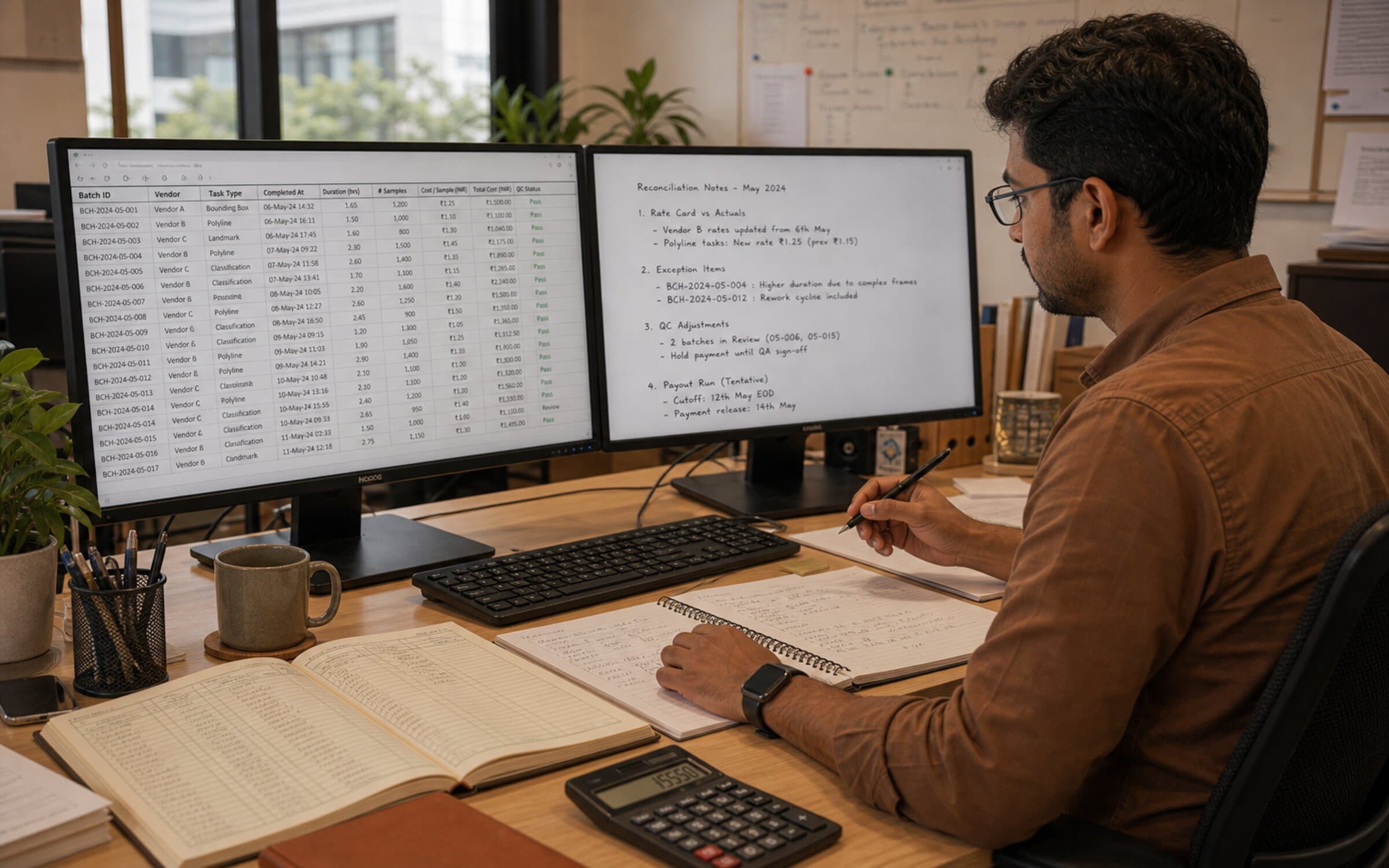
ig-platform annotation fails on robotics because annotators lack domain expertise. A crowdsourced worker can label a bounding box or classify a single frame, but cannot recognize contact forces, predict gripper failure modes, or maintain consistency across a 2000-frame sequence. The cost-per-frame looks cheap initially—but the cost compounds when models trained on imprecise data fail on real robots. This is not a pricing problem. It's a capability problem.
What gig platforms are good for (and not good for)
Gig-platform annotation — Mechanical Turk, Upwork, specialist crowd platforms — works well for:
- Binary classifications ("Is this image a cat?") where agreement is obvious
- Large, homogenous datasets (100K+ images) where quality dilution is acceptable
- Non-critical tasks where errors don't halt production (content moderation, sentiment scoring)
It does not work for:
- Robotics training data, which is expensive to acquire and can't be reshot
- Tasks requiring domain expertise (understanding robot kinematics, detecting contact)
- Programmes where iteration cycles depend on annotation quality
- Data that feeds safety-critical or regulated systems
Where expertise fails become cost problems
Quality review overhead: Gig workers lack the domain context to label robotics data correctly. You must employ experienced annotators to review, correct, and recalibrate crowd labels—work that can equal or exceed the original annotation effort.
Rework cycles: Mislabeled gripper states, contact points, or joint angles don't surface until the model trains and fails on real robots. Then you rework annotations, retrain, and lose weeks of iteration time.
Consistency drift: By frame 300, gig annotators have reinterpreted your rubric. "Gripper open" on frame 50 no longer means what it meant on frame 300. Fixing this consistency gap requires specialist intervention across the entire dataset.
Knowledge loss on iteration: When your rubric changes, gig workers move on. A specialist team pivots in days. A gig platform requires weeks of re-recruitment and retraining—or you accept that the new data won't match the old.
A concrete example: humanoid annotation
You need to label 2000 frames of humanoid robot video — joints, gripper state, contact points.
Gig platform path:
- Post to Upwork: "Label robot joint angles and gripper state"
- 10 workers take 200 frames each
- Result: joints labeled inconsistently, gripper states misunderstood, contact points missed
- Your ML engineer spends 40+ hours reviewing and correcting
- Models trained on this data fail on real robots—not by 5–10%, but by 35–40%
- You rework the annotations, retrain, and repeat
- Total calendar time: 8–12 weeks, including iteration delays
Specialist team path:
- Hire roboticists with annotation experience
- 2000 frames with proper joint calibration and contact-point labeling
- QA by a second specialist ensures consistency across all frames
- One iteration cycle where the rubric is refined—specialists adapt quickly
- Total calendar time: 4–6 weeks
- Models trained on this data work at 90%+ real-world success on first deployment
The specialist path requires higher upfront investment but achieves deployment-ready quality and dramatically shorter iteration cycles. You deploy faster and avoid the compounding cost of rework.
When gig platforms really fail
Safety-critical applications: A self-driving car's perception pipeline can't tolerate 25% mislabeled frames. Gig annotation is unsuitable.
Complex spatial reasoning: Understanding how a robot's gripper contacts an object requires experience. A gig worker will miss contact frames or label them inconsistently. This breaks downstream models that predict contact forces.
Embodied multi-step tasks: "Pick, transport, place" tasks require annotators to understand the full task arc. Gig workers often see individual frames in isolation and miss task structure.
Long-horizon video: A 10-minute robot video has 6000 frames. Asking gig workers to label frame-by-frame leads to fatigue and degraded quality on frames 4000+. Specialist annotators pace themselves and maintain consistency.
Where gig platforms are genuinely suitable
Gig platforms work for tasks where domain expertise is not required:
- Binary classifications on large datasets (Is this a cat or not?) where disagreement is rare
- Simple bounding boxes on static, unambiguous scenes where no temporal consistency is needed
- Commodity annotation on non-robotics data where errors are recoverable
For robotics, they are rarely suitable. The moment your task requires understanding of physics, kinematics, task structure, or consistency across sequences, gig platforms become a liability disguised as a cost saving.
What this means for you
For robotics annotation, expertise is the limiting factor—not cost. Cheap annotation fails not because the numbers are wrong, but because the annotators lack the domain knowledge to label correctly. This failure is invisible at first (low per-frame cost looks great) and catastrophic later (model fails on real hardware).
The annotation that works is the annotation produced by people who understand robots—their kinematics, their failure modes, their task structure. This requires hiring specialists, building retention, and treating annotation as an engineering discipline. Upfront investment is higher, but the total cost of ownership—including model training time, deployment debugging, and rework cycles—is lower.
FAQ
Q: Can I use a hybrid approach — gig workers for simple frames and specialists for complex ones? A: In theory, yes. In practice, this creates consistency problems. A gig worker who labels 50% of your data will introduce systematic biases that specialists then have to correct across the entire dataset. The cost of remediation often exceeds what you saved on gig labour.
Q: How much more expensive are specialists than gig platforms? A: Specialist annotators typically cost 2–3x per frame compared to gig platforms. But when you account for rework cycles, model retraining, and deployment delays, total cost of ownership often favours specialists. Gig platforms look cheaper on spreadsheets; specialists are cheaper in calendar time.
Q: What if I start with gig workers and upgrade to specialists later? A: Your early gig-annotated data becomes a liability. Specialists will either re-annotate from scratch or spend weeks correcting accumulated errors. The transition cost is high. Invest in specialists from the start for robotics work.
Q: Is there any robotics task where gig annotation actually works? A: Simple object classification on static images, if you don't care about temporal consistency. But the moment your data contains sequences, spatial relationships, or domain-specific physics, gig platforms become unsuitable.
Q: How do I know if annotation quality is the real problem? A: Deploy your model on real robots. If it fails on tasks that looked correct in simulation, annotation quality is likely the culprit. Ask: what pattern did the model miss that a domain expert would have caught?
Q: What's the minimum team size for annotation specialists? A: For robotics, one dedicated specialist can manage quality review for 3–4 junior annotators. But if you're outsourcing entirely, budget for at least 2–3 full-time specialists with domain expertise.
Treat gig platforms as a red flag in robotics. If the price sounds too cheap, it is.
Explore professional annotation teams or learn about building specialist annotation programmes.