umanoid robots — systems with two arms, a torso, and a head that mimic human movement — generate visual data at a completely different complexity level than fixed arms or mobile bases. Annotating this data demands precision in joint state, contact points, and task semantics that many standard annotation platforms weren't designed for.
The humanoid annotation challenge
A humanoid arm reaching for an object is not a single trajectory; it's a coordinated sequence involving shoulder, elbow, wrist, and gripper state, plus the robot's balance and torso orientation. An annotator must label not just "the robot reached," but how it reached — which joints moved, what the contact sequence was, and whether the task succeeded.
This complexity is why humanoid annotation requires specialists. Crowd-sourced annotators without robotics experience will produce inconsistent, low-confidence labels. In our experience, a domain-trained annotator labels 3–4 hours of humanoid video per day at 98%+ accuracy; a generalist might manage 30 minutes at 70% accuracy.
Joint state and pose schema
Start with a skeleton model — the kinematic chain of your specific robot. For a humanoid, this typically includes:
- 7–8 DOF per arm (shoulder, elbow, wrist, gripper)
- 3 DOF torso (pitch, roll, yaw)
- 2 DOF neck (pan, tilt)
- Optionally, legs if bipedal locomotion is part of your task
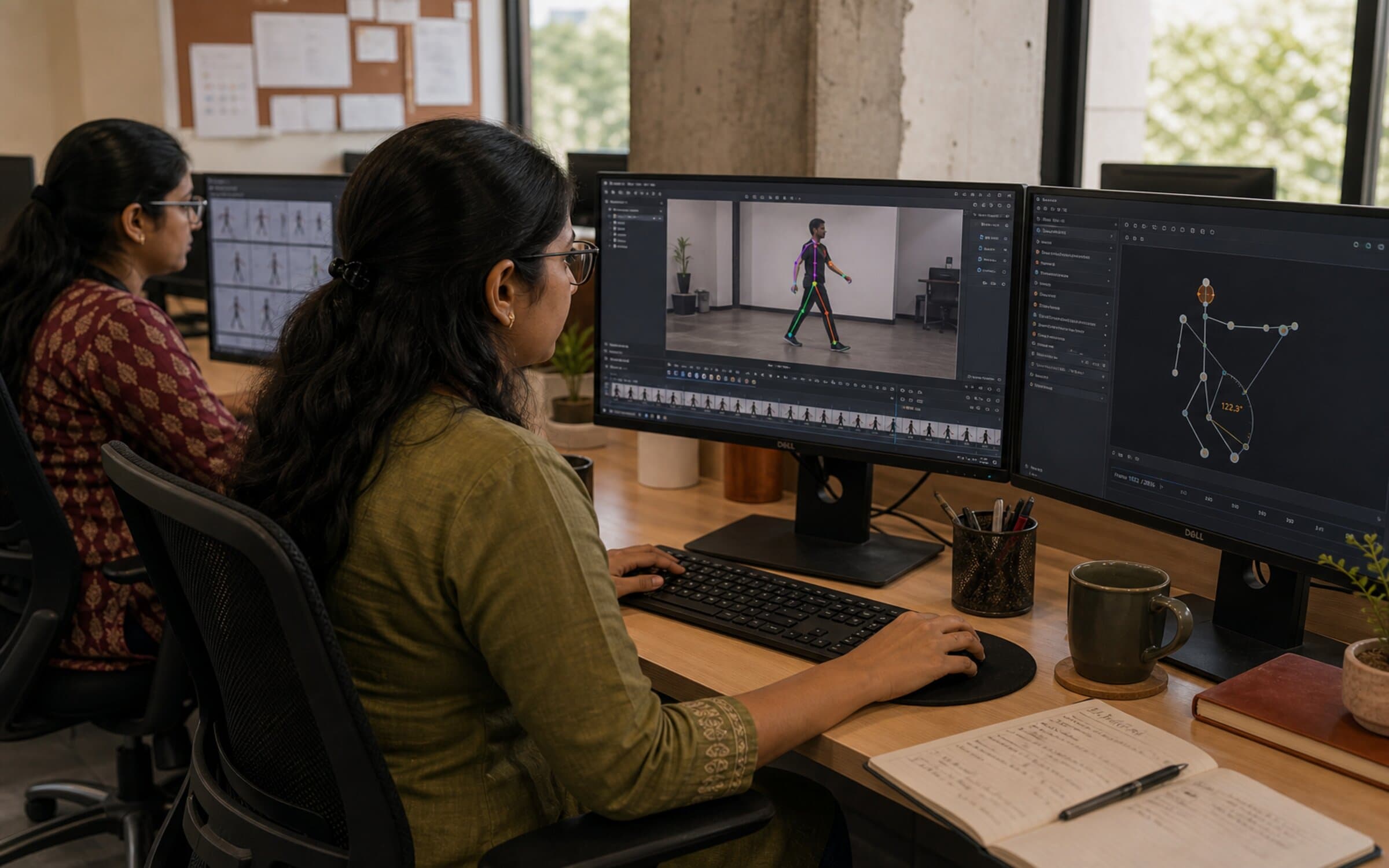
For each keyframe (typically every 2–5 frames in humanoid video), annotators label 3D joint angles or pose estimates. This is not done by hand — use a pose-estimation backbone to generate candidates, then annotators correct outliers and verify continuity. Pose estimation alone is ~90% accurate; human review pushes combined accuracy to 99%.
Contact points and interaction topology
Humanoid annotation must capture when and where the robot touches objects. Common labels:
- Grasp points: Hand contact on object (fingertips, palm, full hand). Include grasp type (pinch, power, precision).
- Body contact: Did the robot's arm, torso, or shoulder contact the scene? Label contact frame and contact geometry (point, line, surface).
- Stability points: Which limbs or contact points support the robot's balance during a reach?
Contact topology — how many points, their sequence, and their spatial relationships — is what distinguishes a successful approach from a collision. Miss a single contact change, and the model misses the task structure.
Task decomposition and sub-actions
Humanoid tasks are almost always composed of smaller actions. "Put the mug on the shelf" breaks into: approach object, grasp, lift, transport, place, release. Annotators should label these sub-actions as spans (start frame, end frame, action label, success/failure).
Sub-action labels let you train shorter, more interpretable models and provide richer feedback to reinforcement learning pipelines. They also catch data quality issues — if a grasp spans 500 frames, something went wrong.
Common rubric pitfalls and fixes
Vague joint labels: "Shoulder moved" is not a label. Use angle ranges or discrete states: "shoulder abduction 30–45°" or "shoulder in home position." Test rubric clarity on 50 frames before full production.
Contact detection drift: Annotators fatigue on repetitive contact labeling. Use automated contact detection (pressure sensors if available, or learned detector on visual data) and have annotators verify/correct rather than label from scratch.
Inconsistent task boundaries: Different annotators mark task start and end frames differently. Use a specific trigger: "grasp starts when fingers first touch object," not "grasp starts when the robot intends to grasp." Test agreement on boundary frames; aim for 95%+.
Missing failure cases: Annotators tend to label successful tasks consistently but mislabel or skip failures. Explicitly enforce a "success/failure" field; ensure annotators label failed reaches the same way as successful ones.
Tooling for humanoid annotation
Standard 2D bounding-box tools are inadequate. You need:
- 3D pose visualization (can the annotator see joint angles in a skeletal overlay?)
- Playback at variable speed (slow down at critical moments, speed up through steady-state)
- Frame-level comments (note why a label is uncertain; helps QA)
- Interpolation review for pose sequences (the tool proposes intermediate frames; annotators validate)
Platforms like Encord and Labelbox offer 3D pose pipelines. If you're building in-house, invest in a web-based viewer that overlays skeleton and contact points on video.
Retention and specialisation
Humanoid annotation is not fungible. An annotator who has spent 100 hours labeling a specific robot's kinematics will label 2–3x faster than a new hire on the same robot. Staff retention directly impacts cost and velocity. Plan for 6–12 month engagement arcs, not task-by-task hiring.
We've seen humanoid programmes fail because companies treated annotation as transactional labour. The best results come from dedicated annotation teams — often 3–5 specialists per robot platform — who develop intuition for the system's quirks.
What this means for you
Humanoid annotation is expensive and slow if done wrong, cost-effective and fast if done right. The difference is schema discipline, specialist hiring, and tooling investment. A poorly annotated humanoid dataset will train models that work 70% of the time in simulation but fail immediately on real hardware.
FAQ
Q: How accurate does pose estimation need to be before annotators correct it? A: Aim for 85%+ accuracy on the backbone. Below 85%, annotators spend too much time correcting and fatigue. Above 85%, correction mode (flagging outliers) is more efficient than labelling from scratch.
Q: Should we label every frame or only keyframes? A: Every frame. A humanoid arm reaching has 12–15 frames of smooth progression. If you skip intermediate frames, you lose contact sequences and collision detection cues that are critical for learning smooth movement.
Q: What happens if annotators disagree on a gripper state? A: Escalate to a roboticist. If disagreement is >10% on any label, the rubric is ambiguous. Refine the definition (e.g., "gripper-open: fingertips >5mm apart") and re-label the batch.
Q: How do I know if my rubric is clear enough? A: Test on 50 frames with a new annotator. They should reach 90%+ agreement with your reference labels within the first 50 frames. Below 90%, the rubric needs clarification.
Q: Can I use motion-capture data instead of video annotation? A: Motion capture gives you ground-truth kinematics but loses visual context. Use both: mocap for joint angles, video annotation for contact points and task success. This hybrid approach trains richer models.
Q: How do I handle tasks where the humanoid fails? A: Label failures as explicitly as successes. Mark the exact frame where the failure occurs (dropped mug, collision, loss of balance). These failures are your highest-value training data because they teach the model what not to do.
Q: What if I can't afford 2–3 full-time specialists? A: Start with one specialist, hire two juniors to label, have the specialist do all QA and rubric refinement. This scales better initially. Retention is critical — losing a specialist mid-project is expensive.
Plan 18–24 months for a robust humanoid dataset. Budget for 2–3 annotation specialists per robot platform. Treat annotation as an engineering discipline, not a data-entry task.
Explore robotics data pipelines or discuss custom annotation programmes with our team.