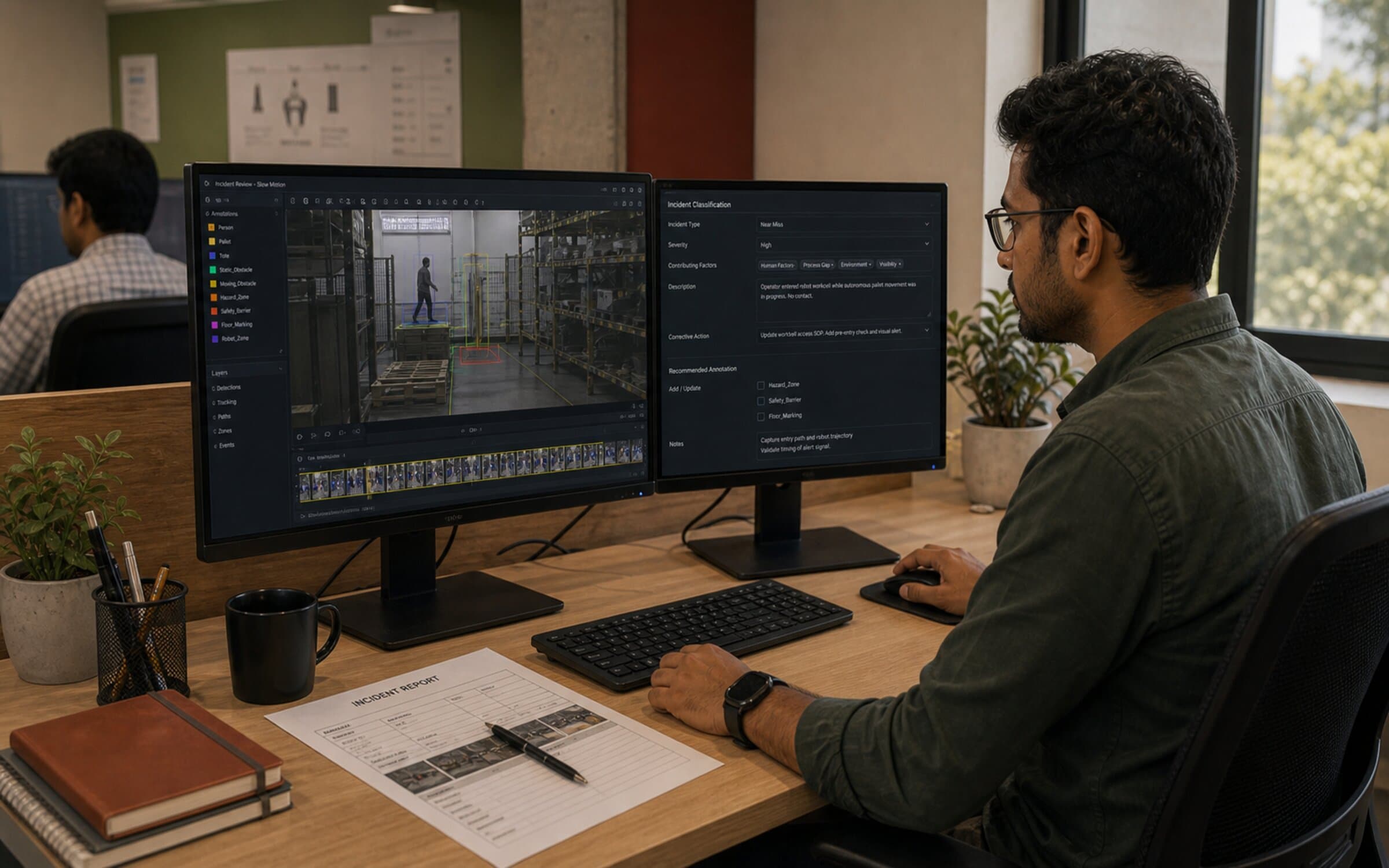
f your robot operates in a safety-critical environment — manufacturing floors with human workers, autonomous vehicles on public roads, surgical robots in hospitals — annotation isn't a data-science task. It's a compliance task.
Safety-critical annotation requires traceability, redundancy, and provenance that standard annotation platforms don't provide out of the box. Missing these controls can expose your company to regulatory liability and product recalls.
Safety standards and annotation implications
ISO 26262 (Functional Safety for Automotive): Requires "traceability of safety requirements to implementation." For annotation, this means every label must be traceable back to a specific engineer, decision, and date. No anonymous crowd-workers. No opaque QA algorithms.
IEC 61508 (Functional Safety for Electrical Systems): Requires documented procedures for data validation and verification. You must document how you annotated, who checked it, and what evidence supports the labels.
Medical device regulations (FDA 510(k), CE mark): If your robot is used in surgery or diagnostics, regulators will demand evidence that training data is representative and correctly labelled. This means:
- Statistical evidence of annotation quality (inter-rater agreement, hold-out test sets)
- Documented rubrics and training procedures for annotators
- Traceability of every label in your training set
Core requirements for safety-critical annotation
Traceability: Every frame must be tagged with:
- Annotator ID (not anonymous)
- Timestamp of annotation
- Software version and tool configuration
- Rubric version used
- QA reviewer ID and timestamp
- Confidence score or notes on ambiguities
Store this as immutable metadata, not in comments.
Redundancy: Safety-critical data must be annotated by at least two independent annotators. If they disagree, a senior engineer (ASIL Level C/D) adjudicates. Document the disagreement and resolution.
Rubric documentation: Your annotation rubric is now a formal specification document. It must include:
- Explicit examples (image + correct label)
- Edge cases and how to handle them
- Decision trees for ambiguous cases
- Glossary of terms
- Version history and approval sign-offs
This is a 20–50 page document, not a Slack message.
Validation evidence: Before deploying a model trained on annotated data, you must show:
- Inter-annotator agreement on a hold-out test set (target: >95% for safety-critical)
- Agreement between annotation and ground truth (if available from sensors or manual verification)
- Performance on edge cases and rare scenarios
- Post-hoc audit trail (which frames came from which annotators, what was corrected)
Annotation workflow for safety-critical systems
A typical flow:
Rubric development (2–4 weeks)
- Engineer defines rubric and decision trees
- Domain expert (human factors, robotics) reviews
- Legal/compliance sign-off
Pilot annotation (1 week)
- Annotate 50–100 frames per annotator
- Measure inter-rater agreement
- If <95%, refine rubric and iterate
Production annotation (weeks to months)
- Two annotators label each frame independently
- Tool flags disagreements automatically
- Disagreement rate tracked (target: <5%)
Adjudication (parallel with production)
- Senior engineer reviews all disagreements
- Documents reasoning for each decision
- Updates rubric if edge case requires clarification
Quality audit (after 50% and 100% completion)
- Random sampling: senior engineer re-labels 5% of frames
- Measures agreement with original annotations
- Identifies systematic biases (e.g., Annotator A always overestimates gripper closure)
Statistical validation
- Report inter-rater agreement (Cohen's kappa, Fleiss' kappa for multi-rater)
- Report accuracy on hold-out test set
- Document all assumptions and limitations
Common pitfalls in regulated annotation
Treating annotation as vendor work: You can hire external annotators, but QA and adjudication must stay in-house. Outsourcing the entire pipeline (including QA) to a third-party vendor breaks traceability.
Inadequate rubric version control: If annotators use different rubric versions, labels are incomparable. Lock the rubric before production; document every change as a new version with a date and reason.
Skipping disagreement analysis: Disagreements aren't failures — they're signal. If 10% of frames have disagreement, you're missing rubric clarity. Use disagreement as a quality flag, not a liability.
Mixing quality levels: If 90% of your dataset is high-precision, multi-annotator labels and 10% is single-annotator, you can't report a single quality metric. Segment the data and report metrics separately.
No long-term traceability: Keep annotation records for the product lifetime (often 10–20 years for medical/automotive). Cloud storage with immutable backups, not local hard drives.
Cost implications
Safety-critical annotation requires significant investment in rigorous processes: rubric development, dual-reviewer annotation, adjudication of disagreements, and comprehensive QA. This discipline is essential for regulatory compliance and product safety, not optional cost-saving. If you're in a regulated domain, the cost of annotation is inseparable from the cost of legal operation.
Regulatory examination and audits
If your product is involved in an incident (injury, product failure), regulators will request your annotation records. Be prepared to explain:
- How was the rubric designed?
- Who were the annotators (qualifications, training)?
- What was the inter-rater agreement?
- How were disagreements resolved?
- What was the final quality assurance result?
Sloppy documentation here can result in product recalls, fines, or litigation. Companies that can produce clean traceability often escape penalty; companies that can't face massive liability.
The human element: why annotators matter
Safety-critical annotation isn't just process; it's people. Your annotators must understand the domain (medical, automotive, surgical) and have authority to flag ambiguities. This is why regulated systems require named, trained annotators — not anonymous crowd workers. The rigour of the process depends on the expertise and attention of the people executing it. A specialist who has annotated 100 safety-critical datasets will spot edge cases and potential failure modes that a novice misses. This embedded expertise is what regulators actually care about.
What this means for you
If you're building a safety-critical robot, annotation discipline is not optional. It's part of your design verification and validation (V&V) process. Budget accordingly, plan 6–12 months, and treat annotation as an engineering discipline, not a labour task.
Start now — even in R&D phase. Building good annotation practices early is far cheaper than retrofitting traceability later. And remember: regulators care about evidence, not effort. A well-documented, modestly-sized dataset beats a large, poorly-documented one.
FAQ
Q: Why can't I use anonymous crowd workers for safety-critical annotation? A: Regulators require traceability to named individuals and documented expertise. Anonymous workers provide no accountability chain, and their qualifications are unverifiable. Safety-critical standards (ISO 26262, FDA 510k) explicitly demand documented evidence of annotator training and authority. Named, qualified teams create the audit trail regulators expect.
Q: How much does safety-critical annotation cost compared to commodity annotation? A: Significantly more — perhaps 3–5x higher per image. The cost reflects named teams, dual-annotator redundancy, formal documentation, QA infrastructure, and expertise. This is not optional overhead; it is the cost of legal operation. A cheaper vendor means cutting corners that regulators will identify during an incident investigation.
Q: What happens if my annotation process fails an audit? A: Product recalls, regulatory fines, or litigation. Companies that cannot produce clean traceability often face penalties. Companies that can produce clear documentation often escape liability. The annotation records are the evidence regulators use to determine whether your process was negligent.
Q: Do I need different annotators for every safety-critical project? A: Not necessarily, but you need consistency. The same team trained on your domain and rubric can move between related projects (e.g. different robot types in the same application). Context-switching between unrelated domains introduces errors. Dedicated or semi-dedicated teams are the standard.
Q: How often should I recalibrate my annotators on a long-term project? A: Monthly minimum. After 1,000–2,000 annotations, annotators develop habits and shortcuts. A formal recalibration session (re-annotate 50–100 frames from your gold set, measure agreement) detects drift before it compounds. Quarterly or semi-annual recalibration is common for projects lasting 6+ months.
Q: Can simulation replace real-world annotation for safety-critical systems? A: No. Simulation covers what you designed it to cover; it misses edge cases and failure modes. Real-world annotation captures what actually happens in deployment. Use simulation as a foundation; use real-world annotation to validate safety margins and catch failure modes simulation missed.
Q: Who should oversee the annotation QA process for a regulated product? A: An engineer or domain expert internal to your organisation, not the vendor. You can hire external annotators, but QA and adjudication must stay in-house to maintain control and accountability. Outsourcing the entire pipeline (including QA) to a vendor breaks the traceability chain regulators require.
Learn more about robotics data compliance or discuss regulatory annotation programmes.