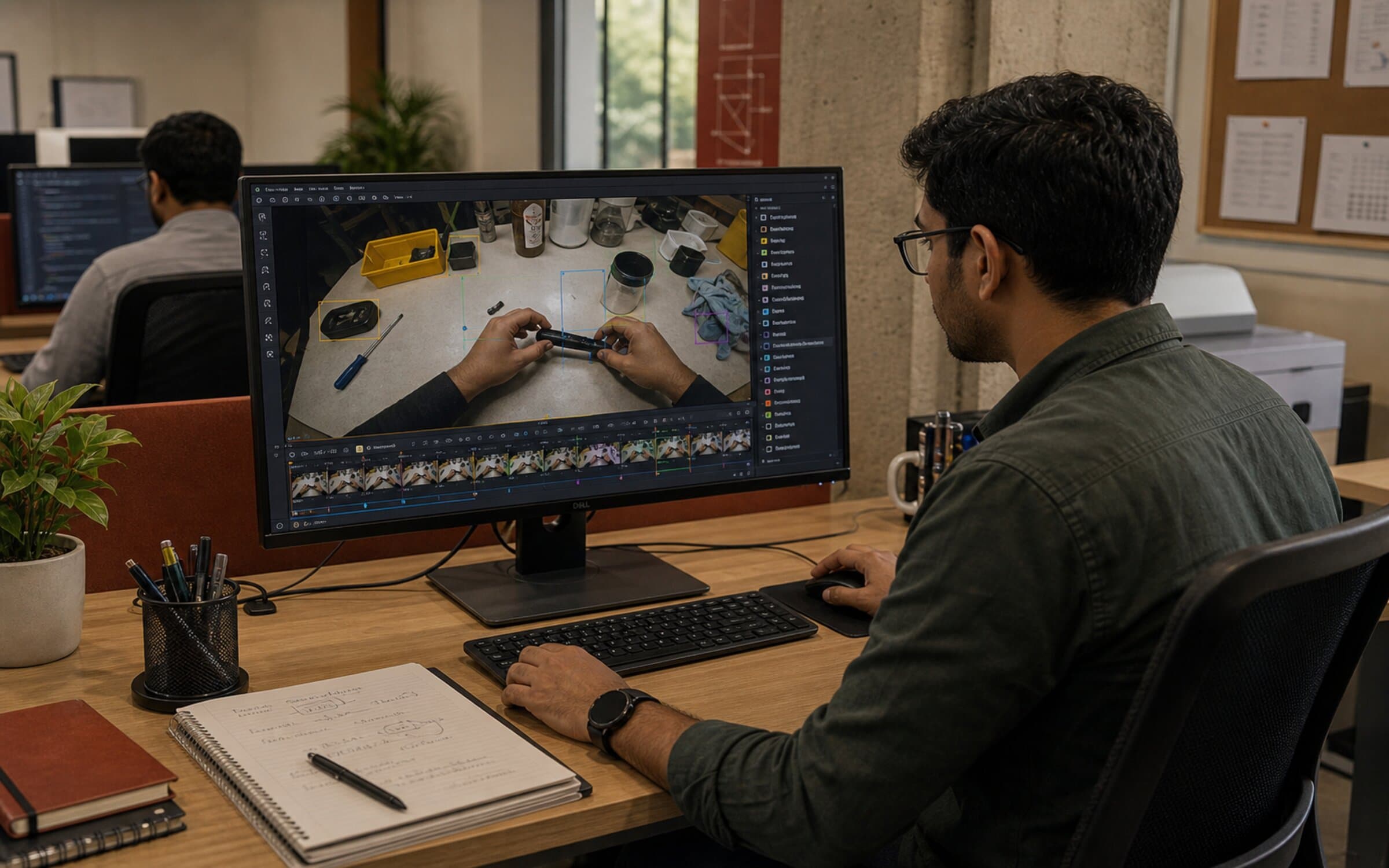
gocentric video annotation labels visual data captured from a robot's perspective — the first-person view from its cameras or sensors. Unlike third-person datasets, egocentric sequences preserve spatial and temporal continuity as the robot moves through an environment, making them essential for training manipulation, navigation, and spatial reasoning models.
What egocentric video looks like
An egocentric stream is typically recorded at 30 fps from a wrist-mounted or head-mounted camera as a robot arm reaches for an object, or as a mobile robot navigates a room. The annotator's job is to label objects, affordances, hand state, and scene context frame-by-frame or across regions of interest. Because egocentric videos range from short clips to long sequences and contain thousands of frames, efficient annotation workflows are critical.
The challenge is not just accuracy — it's consistency across time. A mug appears at frame 120, moves out of frame at frame 380, and reappears at frame 850. Annotators must track object identity and state across these gaps, which breaks easily without schema discipline.
Schema and labeling structure
Effective egocentric annotation depends on a clear rubric. We typically see three layers:
Object detection and tracking: Label each object in every frame (or keyframe + interpolation strategy). Include bounding boxes, class label, and object ID for temporal consistency. For a robot arm task, this means the target object, the gripper state, and any obstacles.
Affordance and interaction: Mark how objects can be used. A mug is "graspable," "pourable," "stackable." For robotics, these affordances guide the model's action prediction — the network learns which objects afford which manipulations.
Hand and tool state: If the robot is an arm or has a gripper, label grip closure, contact points, and tool pose. For humanoid or biped systems, label limb segments and joint angles if your model requires this level of detail.
Frame rate and temporal granularity
Egocentric annotation works best at 10–15 fps rather than full 30 fps. Annotating every frame is labour-intensive and redundant — most scenes change gradually. Keyframe-based annotation with interpolation reduces labelling time compared to frame-by-frame approaches while maintaining temporal resolution. The trade-off is that very rapid motions (fast reaches, impacts) risk being missed; sampling strategy should match your model's temporal receptive field.
Annotation platform considerations
Not all tools handle egocentric well. Frame-by-frame labelling requires smooth playback, timeline scrubbing, and frame-level undo. Platforms like Labelbox and Encord offer video-native pipelines. Look for: per-frame locking (a labeled frame stays locked), confidence scoring (low-quality frames flagged automatically), and interpolation review (annotators visually inspect interpolated frames before submission).
Common pitfalls and fixes
Inconsistent object IDs across segments: An object leaves frame, comes back, and gets a new ID. Enforce an object continuity check — if you lose an object for fewer than N frames, it should keep its original ID.
Affordance labels that drift: Different annotators label the same affordance differently ("graspable" vs. "pickable"). Use a detailed affordance rubric with images, and require 95%+ agreement on a hold-out test set before production work.
Temporal aliasing at slow frame rates: If you drop to 10 fps, rapid hand-object contacts can vanish. Sample critical moments denser; use motion detection to trigger dense annotation near motion peaks.
What this means for you
Egocentric annotation is labour-intensive but unavoidable for embodied AI. It works best with experienced annotators who can reason about spatial continuity and affordance semantics — not crowd-sourced gig workers. Retention matters: a specialist who has annotated 500 hours of robot video will spot schema violations and temporal errors in seconds.
For a multi-quarter programme, plan for significant QA and consistency review to maintain temporal coherence. If you're training a vision-language-action (VLA) model, pair egocentric annotation with language descriptions of the task — this boosts model performance and reduces the need for pixel-perfect labels.
FAQ
Q: What's the difference between annotating egocentric video and third-person video? A: Egocentric video preserves spatial and temporal continuity from the robot's perspective—the robot is moving through an environment, not being observed from outside. This continuity is critical: a single frame is meaningless without context. Third-person video allows annotators to label static scenes; egocentric annotation requires temporal reasoning and object tracking across long sequences.
Q: Can I annotate egocentric video at full 30 fps, or should I sample frames? A: Sample at 10–15 fps using keyframes and interpolation. Full 30 fps annotation is labour-intensive and often redundant—most scenes change gradually. Keyframe-based annotation reduces cost while maintaining temporal resolution. Reserve denser sampling for rapid motions (fast reaches, impacts) that might be missed at lower frame rates.
Q: How do I maintain object identity across long egocentric sequences? A: Enforce a strict object-ID continuity rule: if an object leaves frame and returns within N frames (typically 5–10), it keeps its original ID. If it's gone longer, it gets a new ID. Use an object-tracking check in QA to catch violations. Temporal consistency is the biggest error source in egocentric annotation.
Q: Should I label affordances in egocentric video, and how? A: Yes, if your model needs to predict actions. Affordances (graspable, pourable, stackable) guide action prediction. Use a detailed rubric with visual examples, and enforce 95%+ agreement on a hold-out test set. Affordance labelling is subjective; without a strong rubric, consistency drifts across annotators.
Q: What's the minimum team size for a multi-quarter egocentric annotation programme? A: 3–5 dedicated annotators minimum. Egocentric annotation requires learning—a new annotator starts at 70% accuracy and reaches 95%+ only after 3–4 months on the same domain. Churn introduces constant ramp-up cost. A stable, dedicated team is essential for consistent output.
Q: How do I use VLA (vision-language-action) models to reduce egocentric annotation burden? A: Pair egocentric video with language descriptions of the task. This allows models to learn from less pixel-perfect labels and reduces the need for frame-level precision. A human describes "gripper closes on mug, lifts"; the model learns from the combination of video + language. Language annotation can be faster and still effective.
Q: What annotation tools handle egocentric video well? A: Labelbox and Encord offer video-native pipelines with per-frame locking, confidence scoring, and interpolation review. CVAT also supports video but has fewer automation features. Look for: smooth playback, frame-level undo, interpolation preview, and confidence flagging. The tool is a significant cost lever—choose wisely.
Learn more about robotics data strategies or explore our data enrichment services.